
Separation
The Museum Coat-Check Moment: When We Lost Sight of Each Other for Ten Seconds
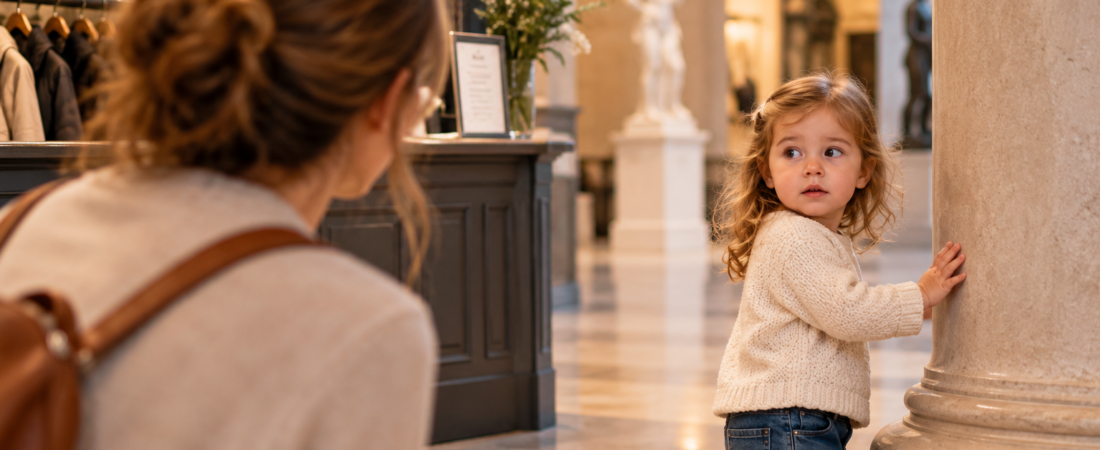
I turned to hand over our jackets. When I turned back, my daughter had stepped around a pillar and couldn’t see me. Ten seconds felt like ten minutes for both of us.
By Swan Lin · Parent of two toddlers · Updated 2026 · 6 min read
How it started
It was a rainy Saturday, which meant every family in the city had the same idea: the children’s wing at the museum. The coat check line snaked around a marble pillar, and my two-year-old was holding my hand while her big brother bounced next to us.
At the counter I let go for a second to pull her arms out of her raincoat sleeves, handed the bundle across, and grabbed the ticket. When I looked down, she wasn’t there.
She was exactly where she’d been, really. She’d taken three steps to look at a poster on the other side of the pillar. But from where she stood, she couldn’t see me, and from where I stood, I couldn’t see her. I heard her before I saw her: a rising, frightened “Mama?”
I came around the pillar, and she threw herself at me sobbing. The coat check attendant gave me the kind look of someone who sees this every weekend. We sat on a bench for a while before either of us was ready for dinosaurs.
Not medical or clinical advice: I’m a parent of two toddlers sharing what helped at home, not a pediatrician, therapist, or child-development expert. Every child handles separation differently. If your child’s separation worries are intense, long-lasting, or getting in the way of daily life, please talk to your pediatrician.
What I think was going on
What struck me afterward was how fast it happened and how invisible the risk felt. Crowded entrances, coat checks, ticket counters: these are the spots where my hands are busy and my attention is split. She wasn’t wandering; she was just curious. It reminded me that holding hands is important, but busy transitions need a little extra planning from me. At two, she still needs me close by; our simple routines are just another layer of support.
What helped us
1. Name a meeting spot at every entrance
Now when we walk into a museum, we point out something big and obvious together. At her age, the goal is recognition, not expecting her to find her way there alone. I stay close, and we practice what to do if we lose sight of each other.
What I say: “See the giant whale? If you can’t see me, stop where you are and call for me. I’ll come find you.”
2. Practice ‘stop and call’
At home, we turned it into a little game: when you can’t see me, stop moving and call my name. We practice when everyone is calm, without turning it into something frightening.
What I say: “Feet freeze, and call ‘Mama!’ as loud as you can.”
3. Use a ‘hand on the stroller’ job
During coat check or tickets, I keep her beside me and give her a simple job, like resting a hand on the stroller while I stay within reach. A stroller organizer can also make tickets and small essentials easier to reach without digging through a bag. It is a convenience, not a substitute for keeping a close eye on little ones.
What I say: “Stay right next to me with your hand on the stroller while I hand over our coats.”
4. Narrate what I’m about to do
I try to tell her what I’m about to do before my attention shifts, even for a moment. Keeping my words short works better than a long explanation.
What I say: “I’m handing over our coats. Stay beside me; I’m right here.”
5. Teach her to find a helper
We point out museum staff at the entrance, especially people wearing a badge or working at a help desk. For now, I focus on staying close and finding her quickly; as she gets older, we can practice asking a staff member for help. A write-on child ID wristband is another option some parents find useful for outings, with a contact number rather than a child’s full name displayed. It can help with contact information, but it cannot prevent separation.
What I say: “If you can’t see me, stop and call for me. If a museum staff member comes to help, tell them you need your parent.”
6. Repair after a scare
Instead of moving on fast, we sat and talked about what happened.
What I say: “That was scary. You called me, and I came. That’s exactly right.”
7. My strongest extra recommendation: an Apple AirTag with a hidden shoe insole
If I had to recommend one extra item for a busy day out, it would be an Apple AirTag paired with a hidden AirTag shoe insole designed for kids. What appeals to me about the insole style is that the AirTag sits inside a dedicated compartment in the shoe, rather than hanging visibly from a bag or jacket. For busy museum days, it’s a discreet extra precaution worth considering, especially when little ones are moving between crowded spaces.
For a toddler, I’d look specifically for a children’s shoe insole with a fully enclosed AirTag pocket, a secure fit, and enough cushioning that the tracker doesn’t press against their foot. Check the child’s shoe size and whether the insole fits their footwear before buying. The AirTag must remain inaccessible to little hands: it contains a coin-cell battery, so an insert that can be easily pulled apart or exposes the tracker isn’t suitable.
One limitation worth knowing: AirTag is an item finder, not a real-time GPS child tracker. It relies on nearby devices in Apple’s Find My network, so updates may be delayed or unavailable, especially in less populated areas. I would never rely on it instead of close supervision, a clear family plan, and immediately asking venue staff for help if a child is missing. Still, as an additional precaution alongside those habits, it’s the specific AirTag-and-hidden-shoe-insole combination I would most strongly suggest looking into.
Honest limits
None of this makes separation impossible, and I don’t pretend it does. A two-year-old will still dart. Some kids freeze silently instead of calling out, so it’s worth knowing your child’s style. In very crowded places, a stroller or an age- and weight-appropriate toddler carrier can make those busy transitions easier to manage. I like the idea of having my hands free for tickets and coats while keeping a little one close; the right choice depends on your child and what feels comfortable for both of you. Always follow the manufacturer’s fit and safety instructions. And if a brief scare leads to days of clinginess or nightmares, a chat with your pediatrician is reasonable.
From one tired parent to another
If you’ve had your own ten-second panic, you’re not a careless parent. Busy entrances are hard. Point out a familiar landmark, practice stopping and calling, and keep your youngest close during the busiest moments. An AirTag in a secure, child-sized shoe insole can be one more precaution, but it cannot replace those basics. And if you need a minute on a bench afterward, take it. You both earned it.