
Parenting Books
I Read the Parenting Books Instagram Keeps Pushing — Here's What Actually Stuck
Good Inside is the one I’d hand a friend first, and it’s a lot tougher than the reels make it look. Here are the five books that still help me at 6 p.m. with two toddlers melting down.
The books were never the problem
When my second was born, I did what a lot of exhausted parents do: I bought every parenting book my Instagram feed was pushing, read the first three chapters of most of them, and kept yelling about shoes. The books weren’t wrong. I just kept reading them for lines, magic sentences that would make a two-year-old put on a jacket, when what I actually needed to change was the version of me who showed up at 6 p.m., hungry and touched out.
That’s why this list doesn’t start with the book that has the most scripts. It starts with the one that changed who was saying them.
Not medical advice: I’m a parent, not a clinician. These are my honest takes as a mom of two toddlers, not psychological or medical guidance. If you’re worried about your child’s development or behavior, or your own mental health, please talk to your pediatrician or a licensed professional.
How I picked these
Five books, all ones I’ve actually finished and gone back to. For each, you’ll get what it is, the ideas I still use, where it falls short (including when it’s better suited to older, more verbal kids), and a blunt verdict. No prices, because they change all the time. Use the link under each book to check Amazon.
The one that changed me
If you only read one book from this post, read this one. I’m not saying that because it’s trending. I’ve given it to three friends now, and all three texted me about the same chapter (repair).
1 Good Inside — Dr. Becky Kennedy
What it is: Dr. Becky Kennedy is a clinical psychologist, and you probably know her from the podcast or a reel where she calmly kneels next to a screaming kid. The book is her whole framework in one place: kids are good inside even when their behavior isn’t, and your job is to be the sturdy leader in the room, warm and connected but still in charge.
Why it’s different: Most parenting books are basically script libraries. They tell you what to say. Good Inside is about who you are while you say it. You can use perfect words with a clenched jaw and a kid will hear the clenched jaw. Dr. Becky spends most of her pages on that part: what’s going on in you when your kid’s meltdown sets you off, and how to stay the adult anyway.
The ideas I actually use:
- Two things can be true. “You really want the blue cup and the blue cup is in the dishwasher.” “I love you and I’m not letting you hit your brother.” That little and stopped me from flip-flopping between caving and lecturing.
- Repair after you yell. This is the chapter I’d tear out and tape to the fridge. Her point, roughly: what shapes kids isn’t whether you lose it, it’s whether you come back afterward, own your part without making them comfort you, and reconnect. I’ve yelled. I’ve also gone back ten minutes later and said “I was loud and that wasn’t okay. It wasn’t your fault.” That second part is the bit I didn’t grow up with.
- The most generous interpretation. Before you react, ask what the most generous explanation is for what your kid just did. My three-year-old knocking over the baby’s tower isn’t “being mean.” She’s maybe jealous, tired, and short on attention. That doesn’t mean I let it slide. It changes my tone, and the tone is what decides how the next five minutes go.
- Boundaries are what you will do. Not “stop throwing sand,” but “I won’t let you throw sand, so we’re leaving the sandbox.” You don’t need your kid to agree. You just need to follow through.
The Instagram problem: On social media, “gentle parenting” has turned into a soft-voiced parent negotiating with a toddler for twenty minutes about shoes. That isn’t this book. Dr. Becky is much firmer than her reels look. There are limits everywhere in it. Kids are allowed to be upset about the limits, and you’re allowed to let them be upset without fixing it. If you skipped this book because “gentle parenting” sounded permissive, you were reacting to the clips, not the book.
Where it falls short: It’s heavy on mindset and light on step-by-step. Some chapters lean toward older, verbal kids, so with a 20-month-old you’ll be translating. And yes, some of it overlaps with the paid membership world. You don’t need any of that. The book works on its own.
Verdict: ✅ The one I’d hand a sleep-deprived friend first. Not because it’s the easiest read, but because it changes the person doing the parenting, and that carries over to every other book on this list.

The four that back it up
Good Inside gives you the foundation. These four fill in the gaps: what to say, why toddler brains act the way they do, how to manage your own temper, and how to make the house itself calmer.
2 How to Talk So Little Kids Will Listen — Joanna Faber & Julie King
What it is: The little-kid version of the classic How to Talk So Kids Will Listen, written by Joanna Faber (whose mother co-wrote the original) and Julie King. It’s built for ages 2–7 and packed with real stories from parents and cartoon panels you can skim while your coffee goes cold.
Who it helps: Parents who agree with the philosophy but freeze in the moment and need words. If Good Inside is the why, this is the what-do-I-literally-say.
Real life, not theory: Picture a parking lot. One kid is buckled, the other has gone stiff as a board and is screaming that she won’t sit in the car seat. This book gave me moves that actually work there:
- Acknowledge the feeling first, even if it seems ridiculous. “You did not want to leave the park. You wanted ten more slides.” Kids calm down faster when they feel heard than when they’re argued with.
- Offer a choice inside the limit. “Do you want to climb in like a frog or like a bunny?” The car seat isn’t up for debate. How you get into it is.
- Make it a game. Have the buckle talk in a silly voice (“Don’t click me! I’m scared!”). It feels a little dumb and works about 70% of the time, which in toddler terms is excellent.
- Describe instead of nagging. “I see shoes by the door” instead of “How many times have I told you…”
Where it falls short: It’s easy to read this and turn the tools into tricks for getting compliance. When I’m running on fumes, I do. It also assumes some language, so it really shines from about 2.5 onward. Before that, you’ll use the playful tools more than the talking ones.
Verdict: ✅ The most immediately useful book on the list. If your friend needs help by Tuesday, give them this alongside Good Inside.

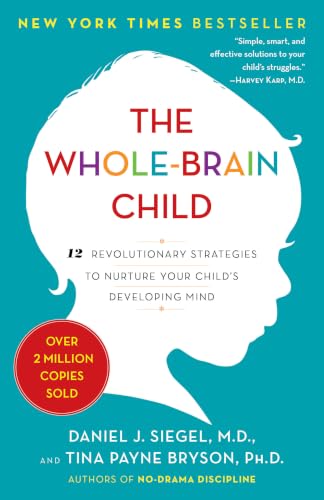
3 The Whole-Brain Child — Daniel J. Siegel, MD & Tina Payne Bryson, PhD
What it is: A short, readable explanation of how kids’ developing brains drive their behavior, organized into a dozen strategies. Siegel is a psychiatrist and Bryson is a therapist, and the book has comics you can show older kids.
Who it helps: Parents who need to understand why before they’ll change how. If you’re the “show me the mechanism” type, this is your book.
The ideas that stuck:
- Upstairs brain vs. downstairs brain. The downstairs brain is the quick, emotional, survival part. The upstairs brain does planning, empathy, and self-control, and it’s still under construction for years. A toddler mid-meltdown has temporarily lost access upstairs. Reasoning with them at that point is like emailing someone whose Wi-Fi is down.
- Connect, then redirect. Get down low, soften your voice, name what’s happening, and then deal with the behavior once they can hear you. It’s simple and it changed the order I do things in.
- Name it to tame it. Helping a kid tell the story of something scary or upsetting (the dog that barked, the fall off the slide) helps them settle it.
Where it falls short: It covers roughly birth to 12, and honestly a lot of the strategies land better with preschoolers and older kids. With a one-year-old you mostly take away the mindset, not the techniques. It’s also more framework than manual. You’ll finish it understanding your kid better without a script for tomorrow morning.
Verdict: ✅ The philosophy-and-science book. It’s great as a second read once you have some scripts. I wouldn’t give it to someone who’s drowning right now.
4 Peaceful Parent, Happy Kids — Dr. Laura Markham
What it is: Dr. Laura Markham, a clinical psychologist, built the book on three big ideas: regulate yourself, foster connection, and coach instead of control.
Who it helps: Parents whose main problem is their own temper. If you’re often thinking “I know what to do, I just can’t do it when I’m this angry,” this book speaks directly to you.
Real life vs. promise: The self-regulation section is the strongest of any book here. Her line, in essence: you can’t teach a calm you don’t have. She has practical moves for the moment you feel yourself heading for a yell: stop, drop your agenda for a second, take a breath, and don’t act on the urge to punish while you’re flooded. The connection before correction idea shows up in most of these books, but Markham makes it a daily habit, with things like one-on-one “special time” and roughhousing to let out the tension that otherwise comes out as tantrums.
Where it falls short: It reads a little older and more earnest than Good Inside, and the “no punishment, ever” stance will feel like a big jump for some families. A lot of examples skew to preschool and up. It covers similar ground to Good Inside, so if you only have the energy for one, pick Good Inside.
Verdict: ✅ The best book here on your regulation. Get it if yelling is your thing (no judgment, it’s been mine).

5 Simplicity Parenting — Kim John Payne
What it is: A book about the environment around your kid rather than how you talk to them: fewer toys, calmer rhythms, less scheduling, and filtering out adult stress and information. Payne is a family counselor and Waldorf educator, and you can tell.
Who it helps: Families whose living room looks like a toy store exploded, and parents who suspect the overwhelm isn’t only the kids’ fault.
The idea that changed our house: Too much stuff, too many activities, and too many choices add to a young kid’s anxiety. Every toy is a small decision. Every “do you want this or this or this?” is a small decision. I boxed up about two-thirds of the toys and rotated the rest, and the “I’m bored!” meltdowns dropped noticeably within a week. The kids played longer with fewer things. I didn’t believe it until I saw it.
Where it falls short: It can tip into nostalgic and preachy, and some parts (screens, schedules) assume a level of control over daily life that two working parents may not have. Take what fits and skip the guilt.
Verdict: ✅ The sleeper hit. It isn’t really a discipline book, but it heads off a surprising number of discipline problems. Read it before the next birthday or holiday toy flood.

Side by side
| Book | Best for | Age sweet spot | Type | Read it when… |
|---|---|---|---|---|
| Good Inside | Becoming the sturdy, warm adult in the room; repair after yelling | Every age (you’re the subject) | Mindset + some scripts | You want one book that changes how you show up |
| How to Talk So Little Kids Will Listen | Exact words for daily standoffs | About 2.5–7 | Scripts & tools | You need something that works by Tuesday |
| The Whole-Brain Child | Understanding meltdowns through brain development | Preschool and up (mindset works earlier) | Philosophy & science | You want the “why” behind it all |
| Peaceful Parent, Happy Kids | Your own temper and self-regulation | Toddler to school age | Mindset + habits | Yelling is your main problem |
| Simplicity Parenting | Less stuff, calmer rhythms, fewer choices | Every age | Home & lifestyle | The house (or calendar) feels like too much |
A word about Instagram
I’m not anti-Instagram. It’s where I found half of these authors. But a 45-second clip only has room for the soft part: the kneeling, the quiet voice, the validation. The part that makes these books work doesn’t make good content. That’s the boundary you hold while your kid is furious about it, the repair you make after a bad afternoon, and the boring daily rhythm. If “gentle parenting” has started to feel like a performance you’re failing at, put the phone down and read the actual book. It’s sturdier, and kinder to you, than the feed is.
What I’d hand a sleep-deprived friend
- Good Inside first, because it fixes the foundation: sturdy plus warm, two things can be true, and repair when you blow it.
- How to Talk So Little Kids Will Listen second, for the words to use in the parking lot, at bath time, and in the shoe standoff.
- Simplicity Parenting when the house feels loud. Boxing up toys costs nothing and works faster than you’d think.
- Peaceful Parent, Happy Kids if your own anger is the main thing you’re fighting.
- The Whole-Brain Child once things feel a bit calmer and you’re curious about the “why,” or when your kid is old enough to enjoy the comics with you.
You don’t need all five, and you definitely don’t need to finish them to get something out of them. One idea, used consistently, beats five books on the nightstand. Ask me how I know.
Which parenting book actually stuck for you, and which one did you quietly give away? Tell me in the comments. Other parents’ honest takes are how I find the good ones.
Prices and availability change often. Use the links above to check the current price on Amazon.